If you have been following our blog then you know by now that Claire is expecting her second child early next year. She has been hard at work trying to figure out the best baby name to pay homage to the great country of Texas (*insert eye roll*). I appreciate that because I have known some people that go to the hospital and deliver a baby without the slightest idea of what they’d like to call their offspring. I mean seriously, you have nine plus months to prepare for this day, you’d think you’d at least have a name. I totally get that people prep and plan in different ways though, so I polled some of our pregnant moms for another MoFoGro (Mom Focus Group) on what they have planned for their big day.
My husband and I are known for our punctuality. You can ask any of our friends and they will tell you “the Morris’ are never late, in fact, they are always early.” That is actually how we met. We both regularly showed up to Cross Country practice 15-minutes early and a bond was formed. Now that I have a LO that 15-minute early arrival is getting shorter and shorter. I hate to admit it, but I have even completely forgotten about some meetings and events that I promised to attend. If it does not get put on my calendar right away, with a bunch of alerts, there is a good chance I’ll miss it. I get overwhelmed just thinking about all the activities and events that will be added to our schedule once DD is enrolled in school and sports. Apparently, 1 in 3 parents have messed up picking up/dropping off their kids from extracurricular activities because of disorganization. Oh geez, that is definitely going to happen to us. I try to keep all of our appointments and DD’s playdates on a Google calendar that is shared with my husband, but I can guarantee you he either a) has forgot how to access it or b) has it disabled so that it does not send him alerts. This is going to be a real problem in a few years and I think I’ve found a solution.
I recently had the pleasure of speaking with Nikki Sacks, the co-founder of PodKeeper, an online organizer for busy parents with busy kids. Nikki told me a little bit about her family and what inspired her to create PodKeeper. Nikki and her husband both have successful careers along with two school-aged kids. Go ahead and add room mom and a youth soccer coach to their resumes and you’ve got a very busy family. Nikki said they wanted a better way to manage all of the day-to-day activities so they came up with PodKeeper. PodKeeper is a game changer for parents as they can easily access the schedules and details for many groups from a single dashboard.
Who here hates group texts and emails?? EVERYONE! They become so cumbersome the more people you add to them and the more details you try to flesh out. Something always gets mixed up or completely overlooked. My husband absolutely hates group emails. I’m pretty sure he just stops reading them after the first reply all. I don’t blame him, but that leaves me sifting through emails looking for important details. Through the PodKeeper web app, parents simply create an online group called a “Pod,” invite other parents to join, and finally have a place to stay on top of all the details. They can also manage household details with their spouse or a co-parent by creating a family Pod. PodKeeper acts as a personal planner app and syncs with online calendars.
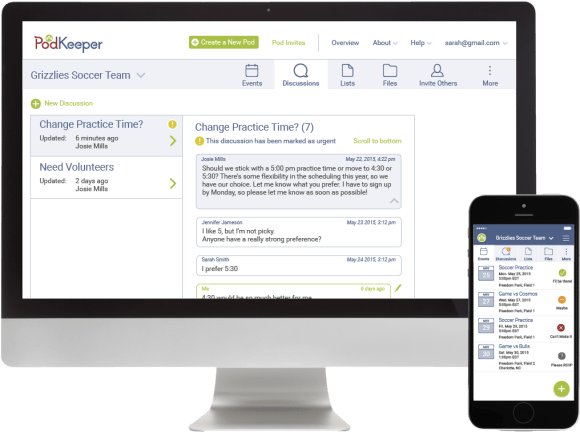
Here is a screenshot of a discussion board for one of the Pods
PodKeeper is geared towards anyone who is in charge of organizing an event, team, class, etc. or who wants to be informed about said event. As an organizer, all you have to do is add the email addresses of the people you want to contact and they will be invited to join your “Pod.” I am excited to share PodKeeper with my family. Just this week, my aunt sent out an updated family contact list with 44 email addresses on it! (We have a big catholic family.) You can imagine how insane those email chains can get when we try to plan family events. When we start using PodKeeper, we will be able to easily schedule events like “pumpkin carving” and “ornament exchange;” create sign up lists for food and party supplies; store files and photos from the events; and even provide important last minute updates. I can already tell you some people in my family (*cough* *cough* my husband) will not join PodKeeper. I asked Nikki if this will be a problem for the group or that individual. I worried that if he does not accept the invite he will be left out. Nikki assured me this would not be the case at all. As long as their email address has been added to the Pod then they will be up-to-date with all the information via email. It also syncs with Google calendar, Yahoo calendar, Apple iCal and Microsoft Outlook.
If that hasn’t already convinced you to give PodKeeper a try, I am not sure you are involved in enough activities. Go volunteer to organize the next playdate and introduce PodKeeper to your group; you will look like a genius!
Powerful Tornado - destroying property with lightning in the background
I shutter to think about having to teach my daughter emergency situations. I know it is 100% necessary, but I legitimately worry I’m going to scare the sh*t out of her. Just thinking about it, my silly mom-brain envisions the most god-awful scenarios she might get herself into. For example, shortly after DD was born we experienced our first Earthquake. It was so small it didn’t even wake my husband, but in my mind I could picture the house splitting in half with the nursery on one side and me on the other. Ridiculous, I know; but I definitely do not want to transfer that fear to her when we teach her about emergencies. I want her to be confident in her abilities to get herself out of danger and to a safe place.
Below is an approach from Dr. Sanam Hafeez – New York City based Neuro-psychologist and School Psychologist – on emergency preparedness that won’t freak your children out.
First, you’ll want to explain the difference between an emergency and a problem to your children. An emergency is a situation that requires immediate assistance from the police or fire department, or requires immediate medical assistance through paramedics or EMTs. A problem is something that they need help with, but does not require emergency services. When your child experiences a problem, and they are home alone, he or she should decide whether to call you immediately, call a neighbor, or whether the problem can wait until you get home.
You’d probably want your child to call you if he or she:
Felt scared
Had trouble getting into the house
Got home and found that the electricity was off
The following issues would warrant an immediate call to 9-1-1:
A fire
Evidence of a break-in
A medical emergency, such as someone being unresponsive or bleeding profusely
To alleviate anxiety, be clear with your children that an emergency is something unusual that happens sometimes resulting in injury or causing damage to things like houses and cars. Explain to them that, every now and then, nature provides ‘too much of something’ like, rain, wind, or snow. Talk about effects of an emergency that children can relate to, such as loss of electricity, water, and telephone service; flooded roads and uprooted trees. Explain that everyone is better able to take care of themselves in emergencies when they know what to do.
Dr. Hafeez points out that, “For younger children, it might also help to talk about who the emergency workers are in your community — police officers, firefighters, paramedics, doctors, nurses, and so on — and what kinds of things they do to help people who are in trouble.” This will clarify not only what types of emergencies can occur, but also who can help.
When to Call 911
Dr. Hafeez explains that, “Part of understanding what an emergency is, is knowing what it is not. A fire, an intruder in the home, an unconscious family member — these are all things that would require a call to 911. A skinned knee, a stolen bicycle, or an argument with a school mate would not. Still, teach your child that if ever in doubt and there’s no adult around to ask, make the call. It’s much better to be safe than sorry”.
Make sure your kids understand that calling 911 as a joke is a crime in many places. In some cities, officials estimate that as much as 75% of the calls made to 911 are non-emergency calls. These are not all pranks. Some people accidentally push the emergency button on their cell phones. Others don’t realize that 911 is for true emergencies only (not for such things as a flat tire or even about a theft that occurred the week before).
Create a Plan with your Child
Teach your child one parent’s cell-phone number or a good contact number. **I remember my mom teaching me our phone number and home address as a song. She even taught me to show the numbers on my hands along with the words.
Choose a location other than your home where your family can meet. You’ll need to go there in case of a fire or an earthquake, for example. Your meeting place might be a local park, school, or shelter. Walk to the site with your child so he/she knows exactly how to get there.
Designate a trusted friend or family member who can pick up your kid at child care or school if you are unable to get there in a disaster situation. Be sure that you give official permission to release your child to that person. **When I was a kid we had a family password. If someone different picked me up from Daycare, that I was not expecting, I was supposed to ask them for the password. If one of my parents had sent them, they would have told them our secret family word.
Make a card with your plan for each adult’s wallet. Include contact names, your emergency location, and designated friend/family member. Put a copy in your school-age child’s backpack.
Inform caregivers and nearby relatives of your plan. Be sure to give a copy of your plan to your child’s teacher too.
If you’re not good at texting, improve your skills. When cell- phone signal strength goes down, texting often still works because it uses less bandwidth and network capacity.
Discuss Region-Specific Natural Disasters
You probably won’t need to waste much time on teaching a child that lives in the Midwest how to manage a hurricane, but he/she will need to know what to do in the event of a tornado. Talking about the natural disasters that are most likely to occur in your area and making a specific plan to deal with them is imperative, especially if you live in a region that’s particularly prone to environmental emergencies.
In the event of a fire, home invasion, or a natural disaster, your entire family will need to have a coordinated evacuation plan to ensure that everyone makes it out of the house safely. Dr. Hafeez stresses that, it is important to explain to your child that all material possessions, even favorite ones, can be replaced and that it’s far more important for them to exit the house than it is to save their belongings. Make sure that he/she knows how to get out of the house if you’re not able to reach her, to make her way to a pre-arranged family meeting place and what she should do when he/she arrives there first.
Role Play Specific Scenarios
Netflix’s Stranger Things – fantasy role-playing D&D
Dr. Hafeez explains that, one of the best ways to determine how much your child knows and what she still needs to learn about emergency preparedness is to role play specific scenarios that she could potentially encounter. There’s a reason why public schools practice routine fire drills: they help kids prepare in a relatively low-stress environment for an emergency so that, in a high-pressure situation they know how to react. Role playing serious injury situations, weather emergencies, a house fire, and even potential intruder situations gives you an idea about what your child knows and helps you teach them more detailed information so that they’re prepared to handle any emergency.
Sanam Hafeez Psy.D
New York State Licensed Neuropsychologist and School Psychologist
Dr. Sanam Hafeez is a New York City based Neuro-psychologist and School Psychologist. She is also the founder and director of Comprehensive Consultation Psychological Services, P.C. She is currently a teaching faculty member at Columbia University.
Dr. Hafeez graduated from Queens College, CUNY with a BA in psychology. She then went on to earn her Master of Science in Psychology at Hofstra University. Following that she stayed at Hofstra to receive her Doctor of Psychology (Psy.D.) She later completed her post-doctoral training in Neuropsychology and Developmental Pediatrics at Coney Island Hospital.
Dr. Hafeez’s provides neuropsychological educational and developmental evaluations in her practice. She also works with children and adults who suffer from post traumatic stress disorder (PTSD), learning disabilities, autism, attention and memory problems, trauma and brain injury, abuse, childhood development and psychopathology (bipolar, schizophrenia, depression, anxiety, etc…) In addition, Dr. Hafeez serves as a medical expert and expert witness by providing full evaluations and witness testimony to law firms and courts.
Dr. Hafeez immigrated to the United States from Pakistan when she was twelve years old. She is fluent in English, Urdu, Hindi and Punjabi (Pakistani and Indian languages.) She resides in Queens, New York with her husband and twin boys.
Mandarin – With more than 955 million speakers, Mandarin claims the top spot as the world’s most common language — and one that often requires professional translation services.
Spanish – Its prominence in the Americas as well as in Europe makes Spanish one of the most common languages, with 405 million speakers.
English – English used to be the second-most common language, but Spanish-speakers have increased much more rapidly over the past 15 years. Still, scholars have named English the world’s “most influential language,” due to the number of speakers (360 million) and the number of countries in which it is spoken.
I like to pretend to be crafty every now and then. I get all of my ideas from Pinterest and am successful at completing most of the projects that I attempt (there are a few Pinterest fails every now and then). I am always so fascinated when I find craft ideas using Duct tape; I never would think to use it in such a way. I remember a girl, when I was in school, who made a purse and backpack out of Duct tape. I thought that was the coolest thing I ever saw. If you are interested in trying your hand at Duct tape crafts check out these projects below and tell us what you’ve made out of Duct tape!
Labor Day typically marks the end of summer and official start back-to-school. Parents everywhere are rejoicing! Or are they? I saw the movie “Bad Moms;” PTA meetings and extracurricular activities sound like a whole lot of extra work that you didn’t have over the summer. If your kids are older you are probably also worried about finding the right tutors and making sure your little Einstein is taking all the right classes to get into college. Geez! I sure do not remember focusing that much time or energy on getting into college, but hey maybe I should have…
As many of you probably already know, I have a love-hate relationship with our cat. I try to love her and all she does is hate me. She is my husband’s cat; his first love. He got her when he was a junior in high school, almost 12 years ago. He carried her to school in a plastic Halloween pumpkin when she was just a kitten and the two of them have been inseparable ever since. She is a petite Tabby cat, with short legs and big beautiful eyes. She can be really sweet when she wants to be, but most of the time she struts around like she is too cool for school. She moved in with us 5 years ago and is constantly trying to get rid of me/come between my husband and I. I thought over time she would learn to love me, or at least appreciate me, since I am the one who feeds her and makes sure she has a clean litter box. No such luck.
It has been a long time coming, but I think my initiation into motherhood is complete. I didn’t get that overwhelming feeling, as soon as my baby was born, that I was meant to be a mom. If you read The Smell Log: Tales from my Labor and Delivery Room, you will remember I was a little disgusted by the alien-being that emerged from my body. In fact, for the first couple of months I walked around in a haze wondering when her real parents were going to come get her so I could get some sleep.
One of the goals of Two and Three Quarters is to provide our readers with useful information along with a touch of our humor and snark. We want other moms (and dads) to be able to use us as a resource and think of us as comrades on the parenthood battlefield. We recently received one of our first samples for review: Home Chef, a weekly meal delivery service. Not only was I thrilled to receive a sample, but also excited to try the service because I love to cook. The following is my review of Home Chef.
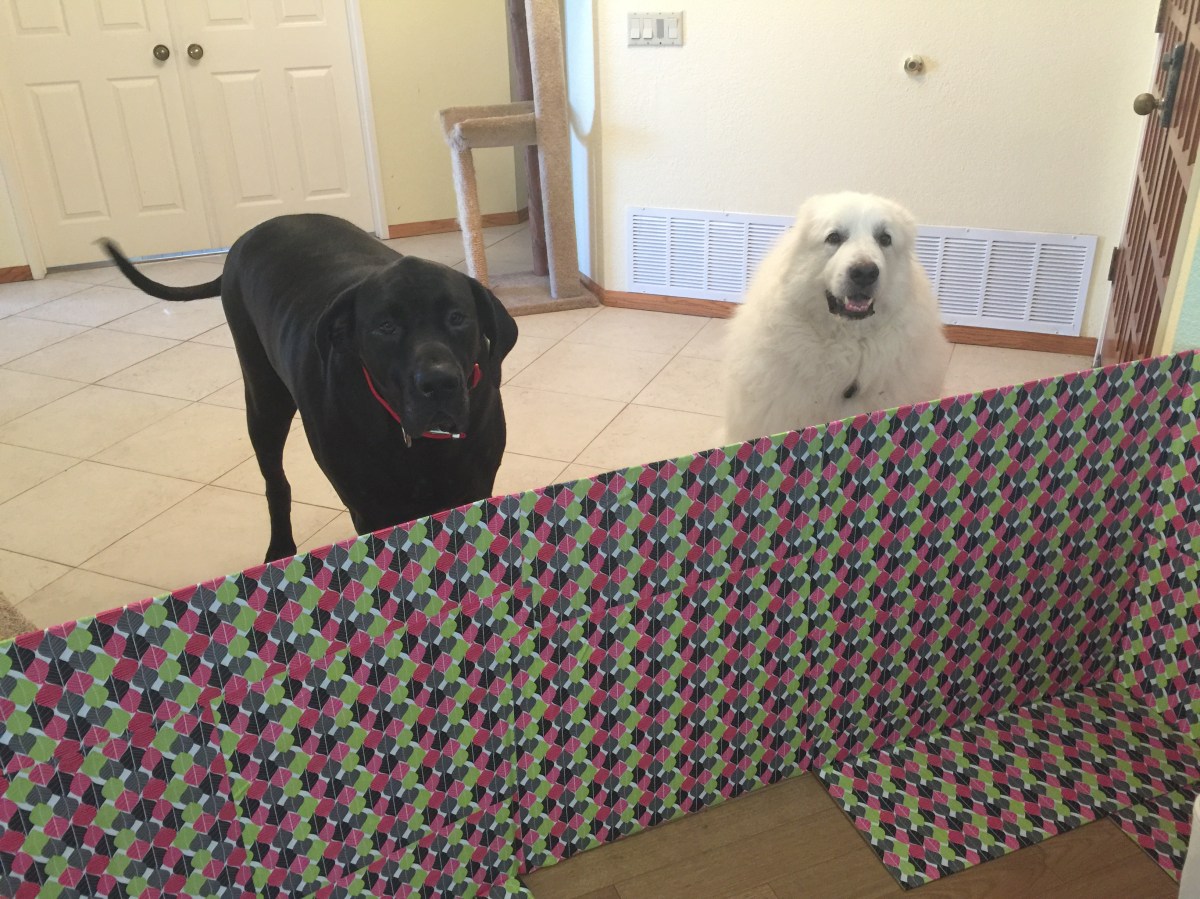
A lot of our friends worried about the safety of our baby before we even brought her home from the hospital. Not because they thought we were going to be bad parents, but because of the size of our dogs. We have a 100 pound Great Pyrenees and a 200 pound Daniff (Great Dane/Mastiff mix). Their size is very intimidating, but they are by far the sweetest dogs in the world. Our friends would ask silly questions like: “What if they carry her away?” “What if they step on her and you can’t get them off?” Um, I’m not going to be leaving my baby unattended on the floor the first day home from the hospital….now the 180th day is another story.
As a FTM I am constantly worried about messing up my kid. I am frequently reminded that I have no clue what I am doing. Should I have taken a test before they allowed me to leave the hospital with a baby?? Probably. I’m trying to follow all the rules. Use the ABCs of sleeping (Alone, on her Back, and in a Crib). Check. Exclusively breastfeed for the first 6 months. Check. When introducing solids at 6-months old start with vegetables first so baby doesn’t get hooked on sugar. Check. No screen time for the first two years. Errr, what?? How is that even possible?
For the first two weeks of DD‘s life I really embraced being a couch potato. Those were the good ole days, when she slept for 20 hours a day. As long as she was in my arms or on my chest I could literally be doing anything else and it would not bother her. I basically lived on the couch catching up on all my TV programs. Being a mom was a piece of cake. Then I read an article that said even having the TV on in the background was not good for the baby. OMG what am I going to do all day? Luckily a new, growing baby is a lot of work and left very little room for watching TV.
Nowadays, I try really hard not to turn the TV on in front of DD. She makes too much noise babbling and yelling at us or the screen to enjoy a show anyways. We wait until she is asleep before watching anything. Sometimes the 45 minutes DH and I watch TV before bed is our only alone time. It is a great opportunity to relax and reconnect. BC we watched a lot of TV together. It was fun discovering a new show with him or re-watching an old favorite. We have spent a lot of money at Best Buy over the years filling our DVD cabinets with our beloved shows. We have even hosted TV show themed parties and movie marathons. Xfinity recently did a study that says TV is the glue to a stronger marriage. I definitely find this to be true, now more than ever. With a baby in the house, it is hard to find time to be a normal couple.
Anyone who has ever met my husband knows he does not like to cuddle. So I cherish the time we spend sitting next to each other on the couch sharing a blanket and watching TV. This is our “cuddle” time. TV brings us together and keeps us together. Just the other day we started watching a new show “Rick and Morty,” and DH asked how I like the show. I told him that I thought the show was OK, but what I absolutely love about it is how hard it makes him laugh. He said that made me sound like a serial killer. If liking something that makes someone I love genuinely happy makes me a serial killer then I guess I’m guilty as charged.
So you can see that TV is a big, important part of our lives. I’d like to be able to include our LO in this bonding time, but I seriously don’t want to cause her any developmental harm. I’m not saying I want her plopped in front of the TV, vegging out for hours during the day so I can have “mommy time”, but I’d like to not feel guilty if we have the TV on after lunch and a show captivates her attention for 10 minutes. There are plenty of other things I can feel guilty about as a mom; I don’t need TV to be one of them.
Being the Nervous Nelly that I am, I did a bunch of research on the topic at hand and found some interesting information. At first, I found that the American Academy of Pediatrics (AAP) specifically discourages any passive screen time for children under 2 years old, i.e., plopping kid in front of TV/using TV as a babysitter. “The concern for risk is that some kids who watch a lot of media actually have poor language skills, so there’s a deficit in their language development. We also have concerns about other developmental issues because they’re basically missing out on other developmentally appropriate activities,” says Dr. Ari Brown, the lead author on the American Academy of Pediatrics 2011 policy statement discouraging screen time for babies under 2.
Ummm, no thanks! The 10 minutes of peace and quiet I get while DD watches TV are not worth her missing the boat on language and other communication skills. Apparently just having the TV on in the background, is enough to delay language development. As parents we speak about 940 words per hour when a child is around, but when the TV is on that number drops to 770! Fewer words mean less learning. Yikes! It is not just the number of spoken words that are crucial to a child’s development, but also the exchange of facial expressions, tone of voice, and body language used during conversation. Whenever one party, child or parent, is watching TV, the exchange comes to a halt.
I totally get what the AAP is saying, but I have a hard time believing that parents are able to stick with this recommendation in this day and age. My LO FaceTimes with her Grandparents at least once a week, she loves sitting with her Daddy when he is playing computer games, and I am constantly using my iPhone in front of her to take our daily Tinybeans photos (if you are not sure what Tinybeans is, check out Claire’s post Keeping up with Tinybeans). Basically, we have already failed her as parents. I refuse to accept this fact so early in the game though. I am also super annoyed with the internet for showing the AAP’s 2011 statement first on all the search engines I am using. Have they not revised this in the past 5 years? FaceTime was barely a thing when this statement came out. Come on guys get with the program! Tell me I’m not making my kid dumb!
Bazinga! More recently (2015), the AAP is rethinking their original ban on screen time for children under 2. They are now suggesting it is OK in a controlled situation where the child is still interacting with a parent or a live person on screen. The AAP still doesn’t want kids watching hours of mindless television or YouTube videos, but “the latest neuroscience research shows that the more a digital experience approximates live two-way communication, the more a child younger than 2 will understand and process it,” Brown said. For instance, when a child is sitting and watching a TV program or a video on an iPhone, there’s not a great deal of activity in the brain. But when the child is watching someone they know or even someone they don’t know on a webcam during a video chat, “there’s a whole lot of brain activity going on,” Brown said. Boom! Winning! I feel a 1000 times better now, don’t you?
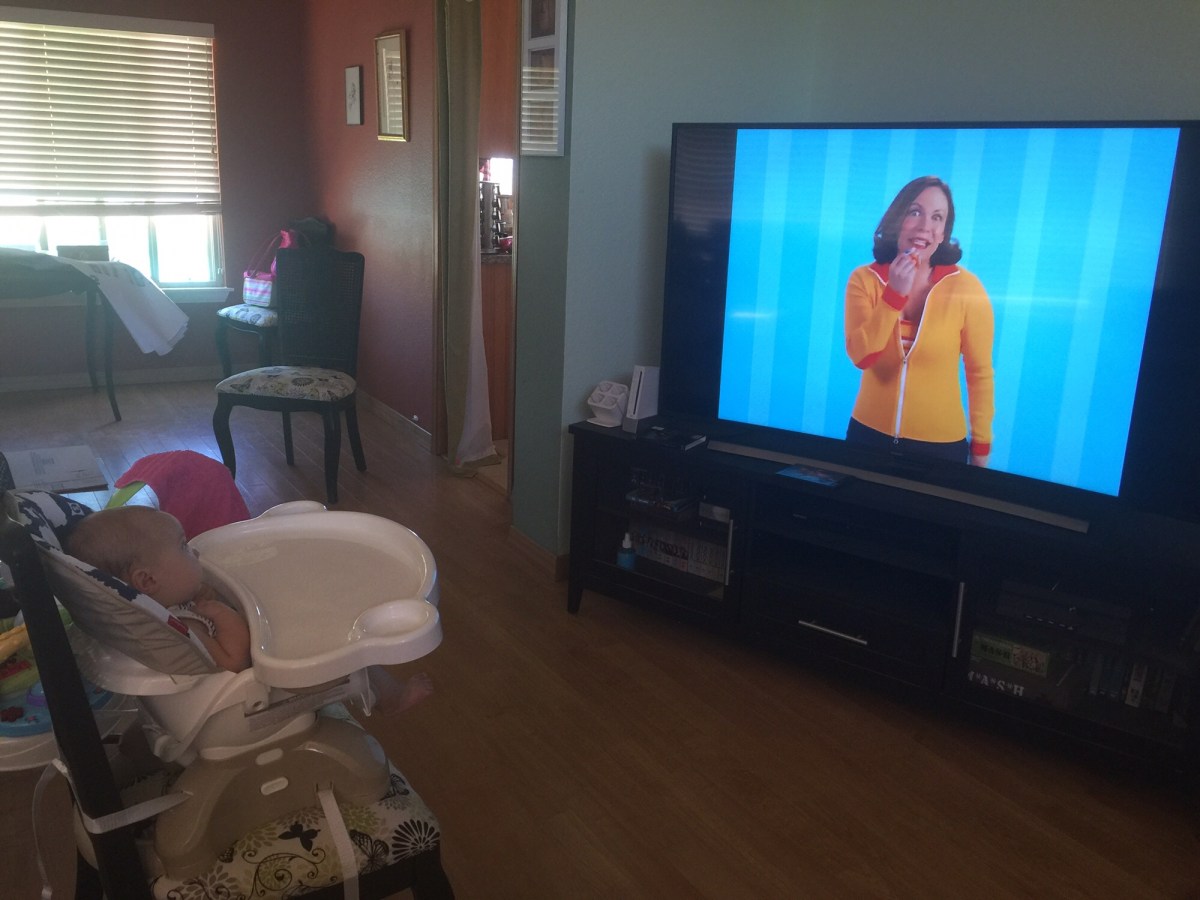
I am a little disappointed that I wont be sharing an episode of Game of Thrones with my LO anytime soon, but any and all guilt that I felt about letting her watch Baby Signing Time while I wash the dishes is completely gone. I may actually be helping her development with that show! It is currently the only show she watches. I think there is something about the other babies on the screen that intrigues her. I know there are a lot of other well-designed shows out there that teach kids literacy, math, science, problem-solving, and pro-social behavior. Children get more out of these interactive programs like Dora the Explorer and Sesame Street when they answer the characters’ questions. Go, Diego, Go, a spin-off from Dora the Explorer, is one of Claire’s son’s favorite shows. Hopefully she can rest easy tonight knowing that this show is not melting his brain, and conversely has been given several awards stating that it is an outstanding children’s program. Way to go Claire!
So basically TV can cause a lot of developmental harm to your child, but if you use common sense and set limits for screen time you will be doing alright as a parent. Babies’ brains are growing fast and are easily influenced by stimuli. Try to eliminate any and all non-interactive screen time for children under two years old. FaceTime, Skype, and other interactive TV shows are OK, but should be utilized with a parent. If you are unsure about a show your child is watching, check out Common Sense Media which helps families make smart media choices. Hopefully this information is useful for other moms out there and removes some of that “mom guilt” we all tend to put on ourselves.









 Two and Three Quarters